First survey results, a UNESCO call that closes 31 August, and the November Kick-Off Conference
Dutch Caribbean Digital Competence Network
From the network
What is in this issue
This edition goes out as everyone is returning from the vacation period, and it opens with a deadline that will not wait. UNESCO and the AI-Lab in Rio have a call for remote access to AI and high-performance computing that closes on 31 August, and every one of the six islands is eligible for it.
Alongside that we share the first results from the network survey in our Newsletter Feature, a call to join the Kick-Off Conference on Aruba in November, and our Introduction to R course landing in Curaçao as Blue Wave Analytics. We also highlight past work of DCDC Network members, including Raymond Jessurun's DCRW2026 keynote.
— The DCDC Core Team
★ Deadline 31 August 2026Headline call
Remote access to AI and supercomputing, open to all Small Island Developing States
UNESCO and the Computing and Artificial Intelligence Laboratory at the Brazilian Center for Physics Research (AI-Lab/CBPF) have opened a joint call for remote access to artificial intelligence and high-performance computing infrastructure. The LAB-IA facility pairs HPC, machine learning, and scientific instrumentation for research across astrophysics, geophysics, materials science, quantum technologies, and biophysics. The call sits under UNESCO's Remote Access to Lab Equipment initiative and its Recommendation on Open Science.
It is open to MSc and PhD students, postdoctoral researchers and junior faculty from Latin America and the Caribbean, from Africa, from Ukraine, and from all Small Island Developing States. Aruba, Curaçao and Sint Maarten sit on the UN's SIDS list in their own right; Bonaire, Saba and Sint Eustatius are covered as part of the Caribbean. Every island in the network can apply. You need a clearly defined research project and strong English, and projects start in October.
So far, our survey attracted 20 responses, primarily from Aruba (n=17), Curaçao (n=2) and one response from Belgium! While this is not a huge response yet, and it is not representative of the needs of all the islands (please still fill out the survey!), we are already seeing some patterns that this feature will briefly discuss.
The language that respondents are most comfortable with is English (n=20), followed by Dutch (n=18), Papiamento/u (n=16), Spanish (n=7) and French (n=2). Based on the data we have so far, this means that we can keep focusing on English as our primary language for communication, and extend this with Dutch and Papiamento/u where possible.
Most of our respondents come from the research or education sector (n=11), with government or public service following (n=7), and several individuals from healthcare, independent research and consultancy, the private sector, or even being based in several sectors. We are happy with this range of backgrounds of DCDC members, as our goal is to also engage the wider research community instead of only the research and education sector.
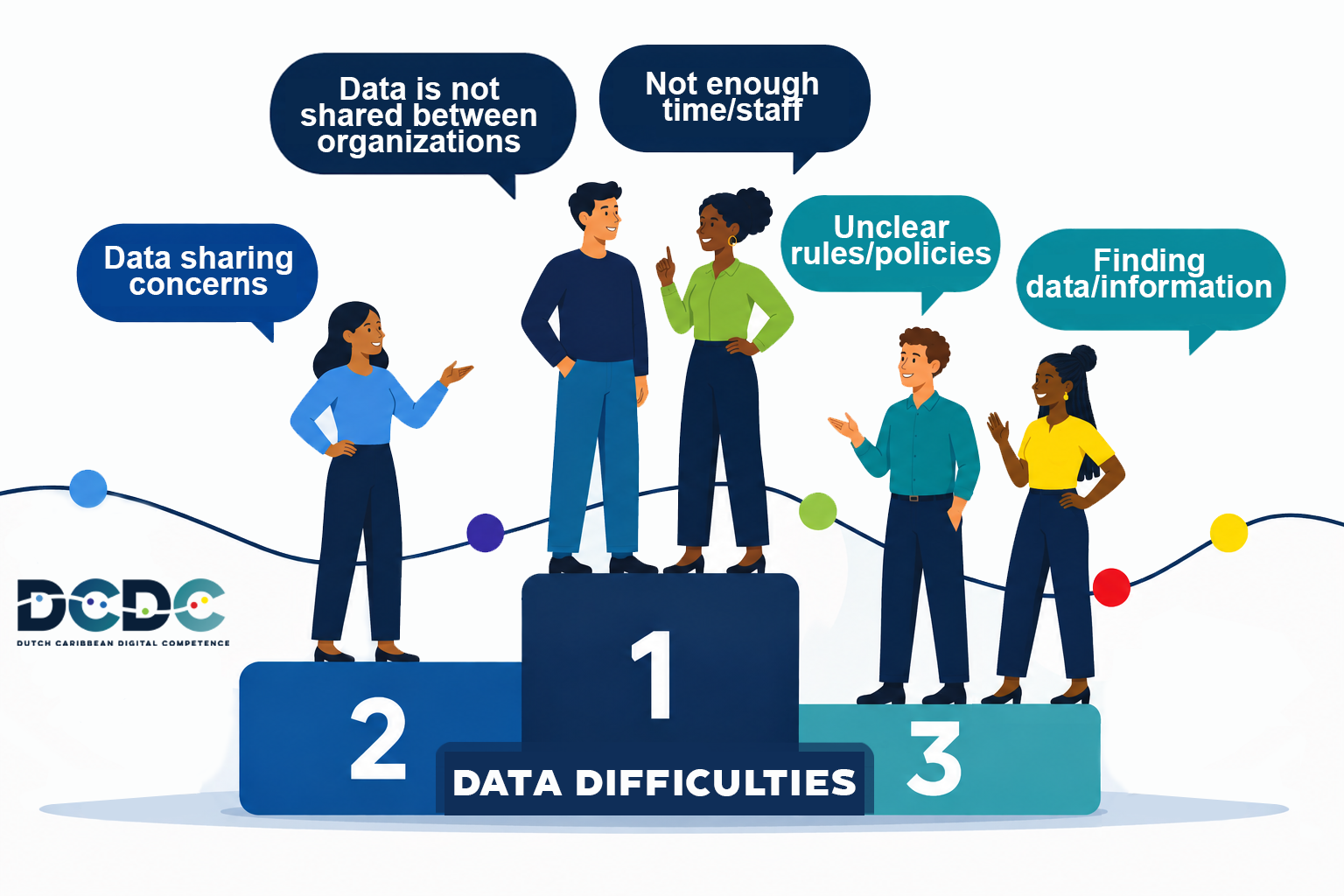
For the question ‘What are the main difficulties you face in your work related to data?’ only one participant indicated that they did not experience major issues! The other 19 respondents indicated the following top 3 of issues, split over 5 difficulties:
Other concerns that people shared in the survey:
How to reach sample size in a small island population
How to store and publish datasets, and how to avoid data leaks
Public trust and lack of education on the purpose of gathering data
Data quality and interpretation
Use of the same language around data
Lack of cooperation or not having a team to help
Lack of tools or software for analysis
To make data sharing easier within our organization, respondents indicated that collaboration with colleagues, as well as trust and collaboration, are key. People have their own storage systems (that do not always result in clean data!) and may be afraid to share data with others, or it may not be clear who has ownership of the data. This was also highlighted in the challenges they experienced, as not all organizations compile data regularly or in a structural manner. Respondents also experience ‘red tape’ between organizations, making collaboration impossible. Two DCDC Network members specifically mentioned the lack of a platform, complying with all legislation, between different institutions to facilitate data exchange. Another member mentioned that there is not yet a shared mindset of responsibility and accountability: the framework surrounding the data should be improved before data sharing is possible.
“Data sharing is frustrated by the lack of an accessible platform for data sharing and the lack of an open data culture in research in Aruba.”
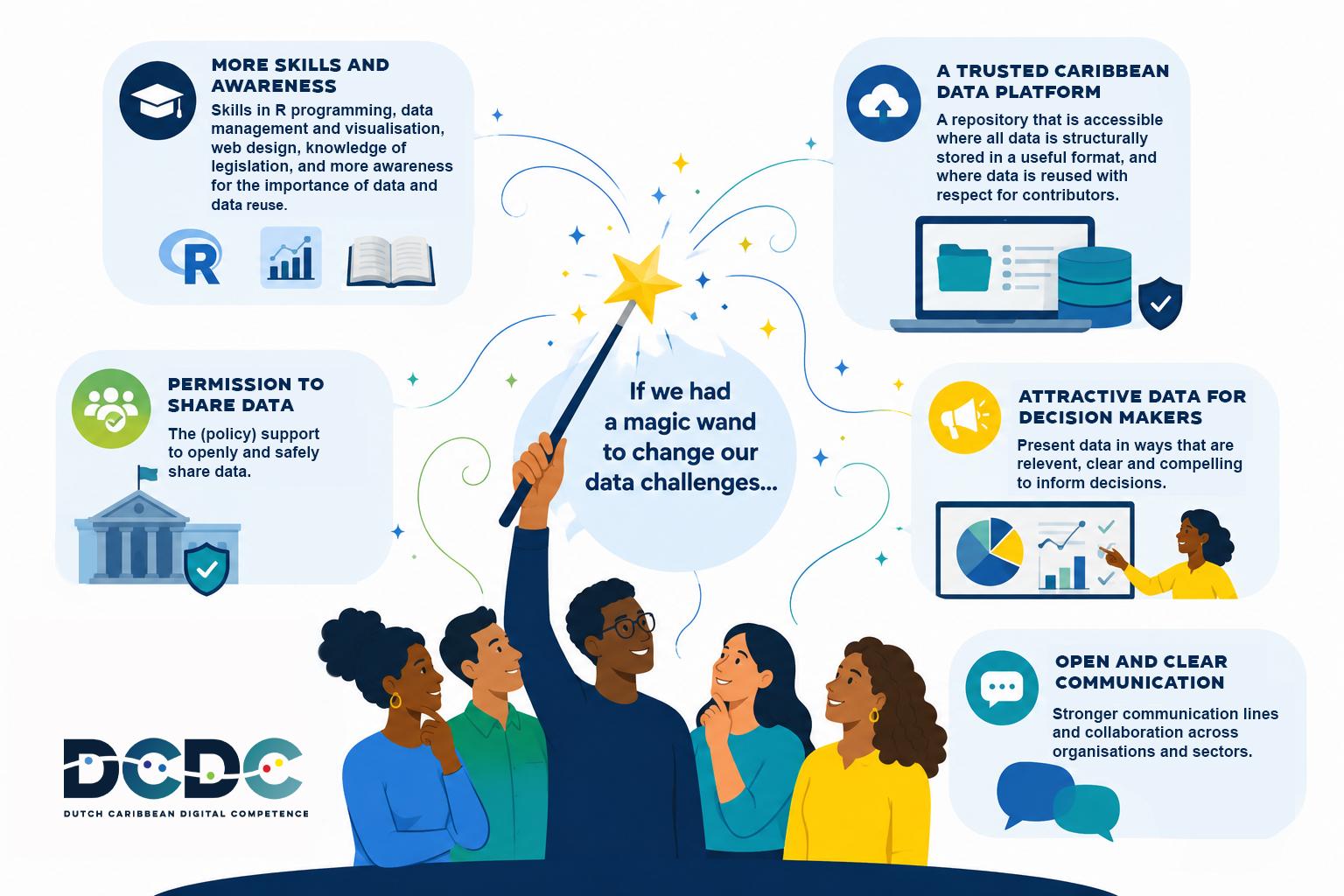
To the question of what participants would do if they had a magic wand to change their data challenges, the obtaining of skills (such as R programming, data coding and cleaning, data visualisation, web design, knowledge of legislation) and awareness (especially for data reuse) was overwhelmingly named. This was followed by a close runner up of the need of a platform where all data is structurally stored and easily shared, such as a repository for the Caribbean, in a format that is useful, and where data is used with respect for the work of the contributors. The political permission to share data was also a wish, as well as knowing how to make data more attractive for decision makers. People also wished that there was more awareness for the importance of data and education, and that the communication lines are more open and clear.
Notably, instead of asking for more funding to be able to pay for expensive licenses, a respondent stressed the need to have access to tools that can replace these paid versions, and open source tools that are more customizable were specifically mentioned (such as R instead of SPSS). More funding was on the wishlist, but then to increase the capacity to be able to make more data available.
In order to address the challenges without a magic wand, respondents were very enthusiastic to offer their help to get access to software and tools, support with training around data management and visualisation, sharing data and working with sensitive data. They also wanted to connect to people with similar interests, as well as international networks and cross-island cooperation. Advocacy for open data and engaging with the wider public was also found important.
Most of the DCDC Network members found training or workshops (whether online or in person), or step by step guides, helpful to increase their digital competence skills. Peer-to-peer learning was also seen as interesting, whereas one-on-one support was found less important.
The majority of our members would like to remain informed of the developments, and are interested in attending training or online sessions. Because of this enthusiasm for attending online sessions we are now more strongly considering hosting some future activities online! Our next opportunity to join the DCDC Network sessions in person are the Blue Wave Analytics: Introduction to R workshop in Curaçao on 23 and 25 September (registration is open, and Marjorie Alfonso is happy to answer questions at marjorie.alfonso@uoc.cw), and our Kick-Off Conference in November on Aruba (10 to 12 November, University of Aruba).
We will structure our Kick-Off Conference in November based on these survey responses, so it is never too late to share your perspective by filling out our survey!
Blue Wave Analytics: Introduction to R comes to Curaçao
Introduction to R for SPSS Users, the two-day course that ran for the first time in Aruba this April, comes to Curaçao this autumn as Blue Wave Analytics: Introduction to R. Same structure and the same objectives: read a CSV, filter and summarise it, plot it, and walk out with a script that still runs tomorrow. What changes is the data. The worked examples run on Curaçao's undefeated CONCACAF qualifying campaign, so participants learn the tools on numbers they already argue about. The football is the vehicle and not the payload: the objectives stay import, dplyr, ggplot, a basic test, and a script that reruns.
It is aimed at researchers, students and analysts moving off SPSS toward reproducible, open tools, and it assumes no prior R. It runs over two days, Wednesday 23 and Friday 25 September, at the University of Curaçao, with a free day in between to let the first day settle. Rendell de Kort, the network's administrator, teaches it, and Marjorie Alfonso, our coordinator in Curaçao, hosts. The two days are one course rather than two, so plan to come to both.
Registration is open now and places are limited. An optional R installation clinic runs before the first day, and we send setup instructions to everyone who signs up.
In August the network became a DataCite member, as a consortium. That means we can mint persistent identifiers for the research outputs our universities share, which is the practical machinery behind the F in FAIR: an output with a DOI can be found, cited and counted, and one without it usually cannot.
Thanks to DOIs, our research outputs become more visible in the wider research ecosystem, and we can more easily analyse what research outputs we have and what impact they have. If researchers have connected their ORCID with DataCite, the research outputs are also automatically added to the ORCID profile, providing a great overview of all the research outputs connected to you as a researcher!
Save the date
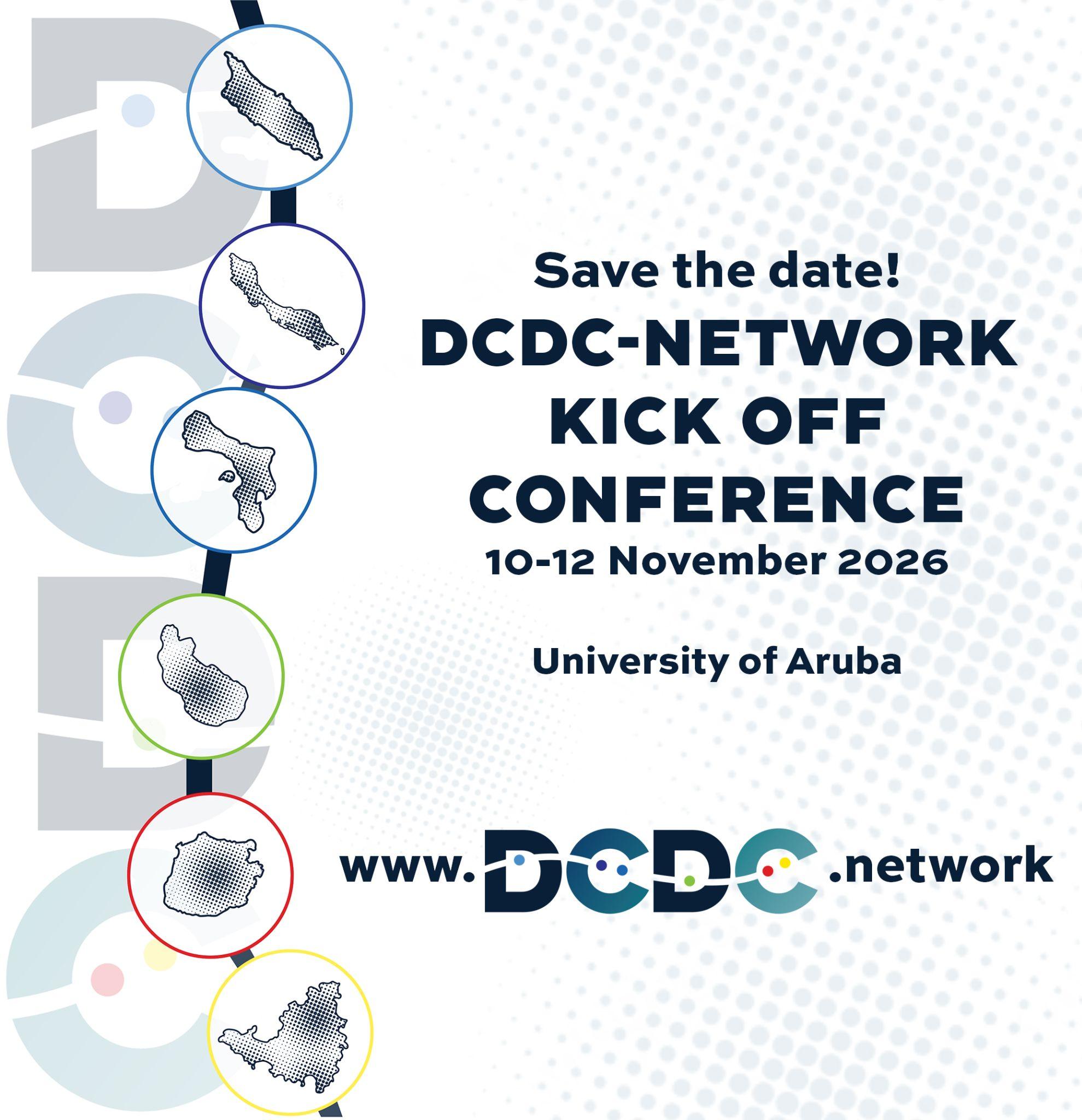
DCDC Kick-Off Conference, 10 to 12 November, University of Aruba
The network's Kick-Off Conference takes place on Aruba from 10 to 12 November. The programme is being built directly from what members tell us in the survey, which is why the survey is still open and still worth five minutes of your time.
We are also looking at co-locating events on 9 and 10 November, and a further event on the 13th is under discussion, so the whole week is worth holding.
Registration, the call for contributions, and the draft programme follow in the next issue.
Kareline was in the first cohort of Introduction to R for SPSS Users, the course the network ran in Aruba this April. We filmed a short conversation with her during those two days about what moving off SPSS actually costs and what it gives back.
Kareline van der Linden, filmed during the April R cohort in Aruba.Recent stories
The network's first CRAN package, islandcodes, featured in Issue 1, keeps the BES islands separable in country-classification joins. Version 0.2.0 has been submitted to CRAN, and a short paper describing the package is queued for the Journal of Open Source Software. Use cases, missing classifications, and edge cases are welcome via GitHub issues or at rendell.dekort@ua.aw.
Worth reading
Three pieces close to what the survey asked for
Building a Wikimedia community in Aruba. A reflection on the Wikipedia on Aruba pilot, published on Wikimedia's Diff blog in July. It is a rare written account of open-knowledge work done on one of our own islands, and it sits next to the survey's finding that awareness matters as much as skills.
Open-washing is everywhere in AI, and four criteria cut through it. Tech Policy Press on how loosely the word "open" gets used in AI, and a practical test for telling genuine openness from the marketing version. Useful for anyone in the network being sold an "open" tool.
Bread and butter: the HopeAruba movement. An account of a grassroots movement on Aruba exploring the question: if a visitor spends 100 florins in Aruba, where does it actually go? A great example of what questions could be explored with public data.
Calls & opportunities
More worth a look
Three further calls open to network members across the Dutch Caribbean, alongside the UNESCO call above.
A workshop reflection, a tool you love, a dataset you wish existed, or a story from your institution? Send a paragraph or a full draft for consideration.