About the DCDC Network
The Dutch Caribbean Digital Competence (DCDC) Network was established in 2025 with funding from Open Science NL. It connects the Universities of Aruba, Curaçao, and St. Martin, and Instituto Pedagogico Arubano, with a shared mission: to make research data more reusable, accessible, and transparent across the Dutch Caribbean.
The training program is one of the network's main vehicles for that mission. Introduction to R for SPSS Users is the first course in the program. This workshop is designed for analysts and researchers across the region who already work with quantitative data and want a path into open-source tooling, moving from SPSS to R.
What we did
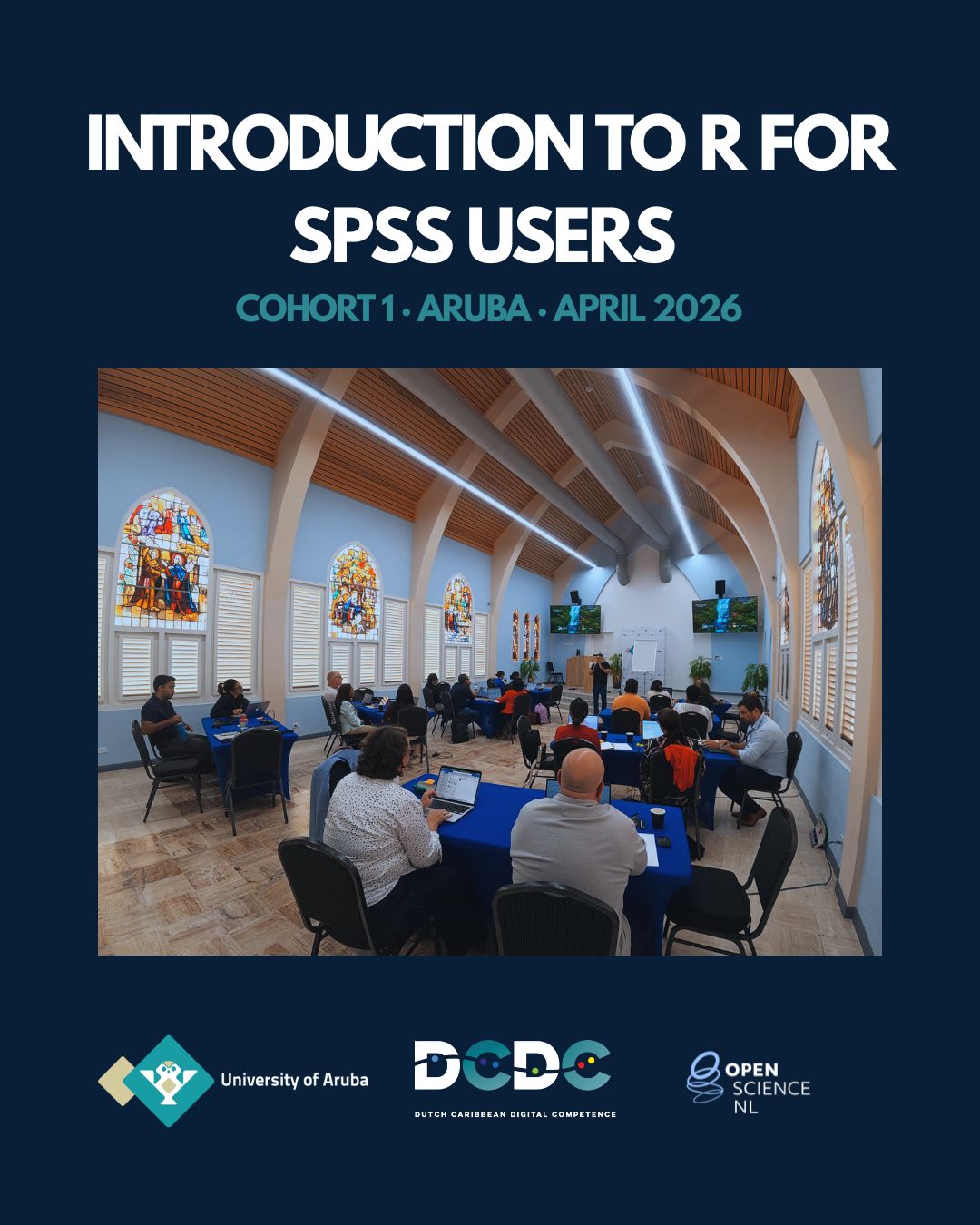
The course is a Carpentries-style (basic programming) two-day workshop. The workshop is hands-on from start to finish, built around locally meaningful datasets (Aruba inbound visitors, baseball reports, CBS data). Participants installed R and RStudio before arriving, worked through the essentials on day one, and moved into visualisation, basic statistics, and reproducible reporting on day two. Rendell de Kort facilitated with the assistance of Esther Plomp, hosted at the University of Aruba MC-Chapel.
The room was deliberately mixed in two ways. Some participants had never opened RStudio before. Others arrived with prior exposure and a clear sense of what they wanted to get out of the two days. The cohort also drew across Aruba-based research and government analysts. This mix in participants is the point: the course is meant to serve the whole digital-competence range that exists in the network, and connect them to peers with similar interests.
What participants told us
Every respondent said they would attend a future DCDC training session. The recommend-to-a-colleague score averaged 8.5 out of 10. On a five-point scale, "I gained new knowledge or skills" averaged 4.5, and "the training met my expectations" averaged 4.5.
We received mixed feedback on the pace of the workshop: for most participants this was just right, but some indicated that it was going too fast for them.
"Lots of info in a high pace. If stuck, you're lagging behind."
From a participant feedback sheet, day 1We hope to address this feedback by adding more exercises to the workshop, which allows faster learners to get more experience while slower learners are able to take the time that they need to fix their issues, allowing them to keep up with the workshop pace.
What participants want next
Three asks came through clearly in the open-text responses:
- More time on data visualisation and data cleaning.
- A working session on uploading and analysing your own dataset, rather than only the prepared example.
- Tools for qualitative research, including text analysis of survey free-text fields and other open-ended data.
The qualitative ask is of interest in particular to SPSS users, as they collect or generate a great deal of text data they rarely analyse. For example, the "Other, please specify" columns in survey instruments, open comment boxes, and interview transcripts. R can handle this analysis in the same manner that participants already learned for numerical data. It is an extension of what they already know!
What changes in future workshops
The text-analysis module, focusing more on qualitative data, will move into the core curriculum as an optional track (as it may not be of interest to participants focusing on quantitative data only). Future workshops will engage with more exercises to allow learners to learn at their own pace.
Thank you
Thanks to the twenty-five learners who sat with the discomfort of switching tools after years of SPSS muscle memory, to the University of Aruba for hosting, and to the DCDC-Network for organizing this workshop! Future workshops will be organized: if you want to be there, the network onboarding form is the way in.
All teaching materials remain open. The course site, episodes, exercises, and data are public on GitHub for anyone in the network to reuse, adapt, or contribute to. This blog post and the figures in it are released under a Creative Commons Attribution 4.0 International (CC-BY 4.0) licence.
Want to join the next DCDC training cohort, or know someone who should?
Complete the onboarding survey