Training
The DCDC Network develops and delivers training that builds digital competence across the Dutch Caribbean. Our courses are designed to be accessible, practical, and transferable, so the skills we build together stay in the region.
Our approach
Every course in our program is built around open-source tools and open training materials. This means participants pay nothing for software, and the materials can be reused and adapted by anyone in the network. We prioritize courses that bridge existing skills to new capabilities, rather than starting from scratch. Our training is grounded in FAIR data principles and reproducible research practices.
Courses
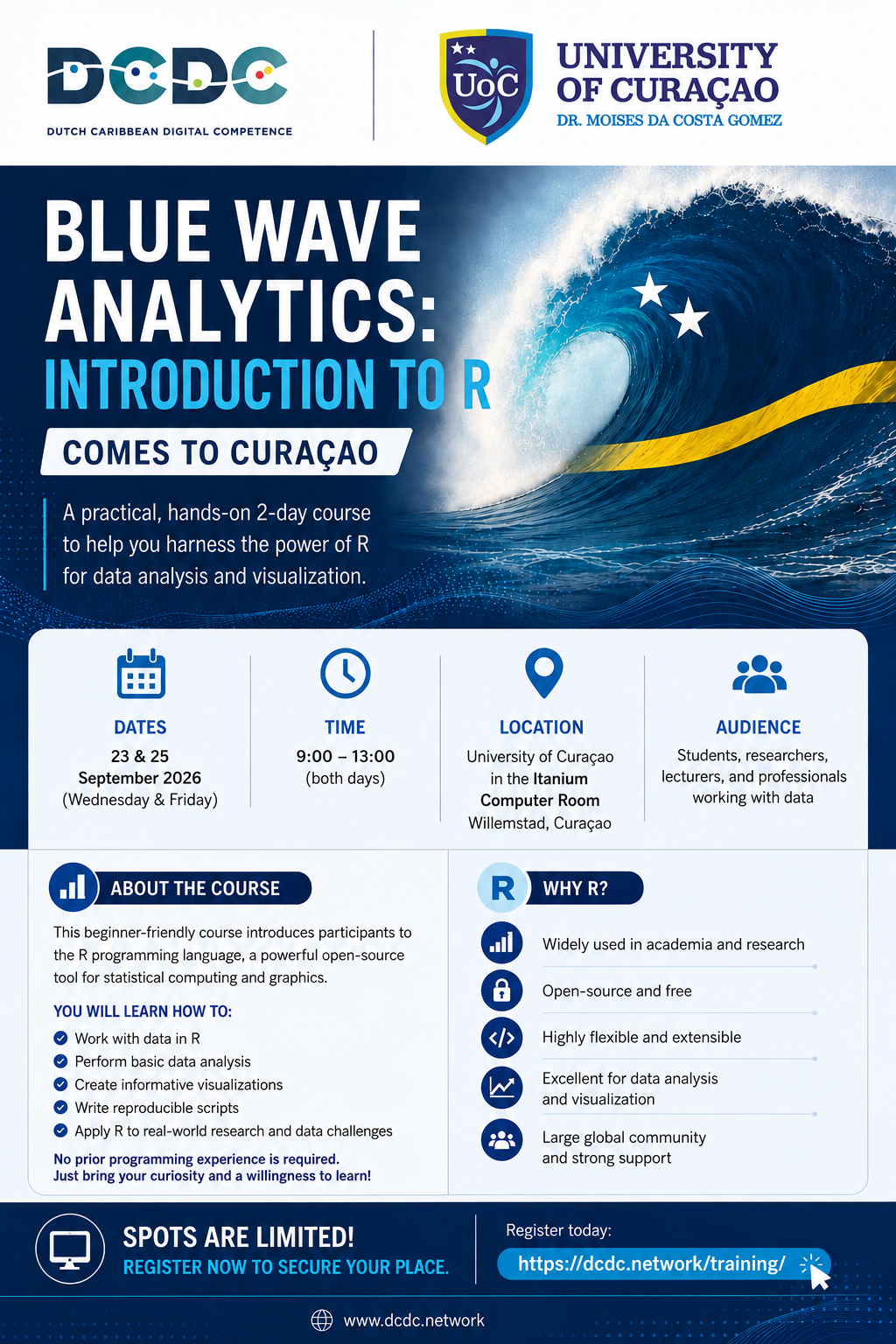
Blue Wave Analytics: Introduction to R
The Curaçao edition of our R course for SPSS users, taught on the qualifying run that took the smallest nation ever to a World Cup. No prior R experience assumed.
Taught by Rendell de Kort (DCDC Network) and hosted by Marjorie Alfonso at the University of Curaçao. Questions: marjorie.alfonso@uoc.cw.
Course materials, open to everyone: dcdc.network/bluewave
More courses coming soon.
The training program expands as the network grows. A St. Martin edition of the R course is in planning, and future topics may include research data management, open science practices, reproducibility, and data visualization. Interested in suggesting or co-developing a course? Get in touch.
Why this matters
Proprietary software creates barriers. An SPSS license can cost AWG 400 or more per year, and that cost falls on institutions already operating under tight budgets. When each island pays separately for the same tools, collaboration becomes harder. Our training program focuses on open-source alternatives that any researcher, student, or government analyst can access at no cost, from any island. That is practical digital competence: skills and tools that work for everyone, everywhere in the region.
External training
Beyond the courses we run ourselves, we point the network to training offered by trusted partners.
What is open for registration right now is listed below. All times shown are Atlantic Standard Time (AST), so check the start time against your own day before you register.
Software Carpentry: Shell, Git and Python
Monday 7 – Tuesday 8 September 2026, 03.00–11.00 AST (09.00–17.00 CEST)
Two days, hands-on and interactive rather than lecture-based, covering Shell, Git and Python. No prior coding experience needed. Note the hours: this is a European workshop, so it starts at 3am in the Caribbean and there is no recording. You need a laptop or desktop with administrative privileges; a tablet will not let you complete the exercises.
Software Carpentry is a lesson program within The Carpentries, teaching basic lab skills for research computing. The DCDC Network is not an official Carpentries partner, but we reuse and build on their materials and infrastructure, so we encourage you to take part. This workshop is organised and run by The Carpentries, not by the DCDC Network.
The CaSDaR and DCC data stewardship series ran from July to August 2026. We will list the next round here once dates are announced.