 By Marjorie Alfonso
Sharing ideas and exploring new perspectives at the OSC-NL Barcamp
The Open Science experience started on 13 October with the OSC-NL Barcamp, an interactive event that brought together professionals, researchers, and others interested in open science. Unlike a traditional conference, the Barcamp encouraged participants to take an active role by pitching topics they wanted to discuss and inviting others to join the conversations. This created an open and informal environment for exchanging ideas, sharing experiences, and exploring new perspectives on open science.
I particularly remember attending two discussions about Artificial Intelligence and a pitch by Marta Teperek from Open Science NL, focusing on themes related to open research data, data sharing, and making research data more accessible and reusable.
Her contribution was particularly relevant to my work in information management and data stewardship. It highlighted the importance of developing practical approaches and collaborative projects that encourage researchers to share their data and apply FAIR principles (Findable, Accessible, Interoperable, and Reusable).
The AI discussions also offered interesting perspectives on the growing relationship between artificial intelligence and open science.
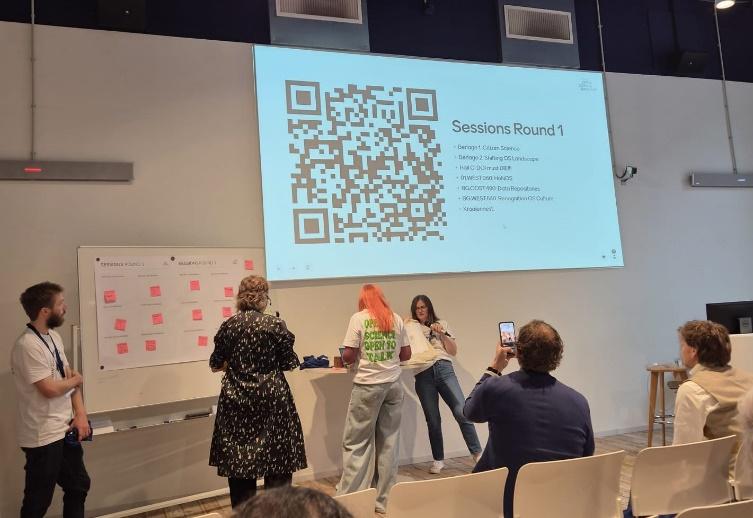
Pitching the first round of sessions at the OSC-NL Barcamp, 13 October.
I appreciated the opportunity to exchange ideas in this informal setting. It demonstrated how bringing professionals together can encourage new perspectives, knowledge sharing, and collaboration across the open science community.
An inspiring start: moving from ambition to action
The Open Science Festival on 14 October brought together more than 400 researchers, educators, research support professionals, and policymakers. It opened with contributions from TU Delft Rector Magnificus Professor Hester Bijl and Minister of Education, Culture and Science Rianne Letschert.
A key message was that open science needs to move beyond simply promoting the idea of openness. The real challenge is putting it into practice and making it a normal part of research.
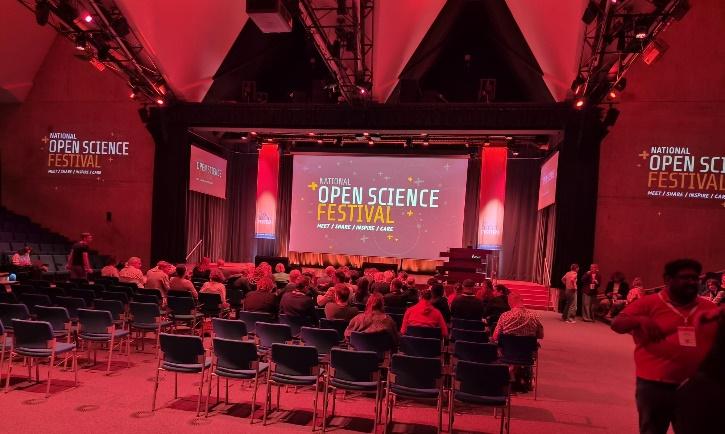
The main hall of the National Open Science Festival, TU Delft, 14 October.
The opening keynote, From Multilingual to Multicultural, by E.M. Lewis-Jong, CEO of Mozilla Data Collective, explored an especially important issue: artificial intelligence may support thousands of languages in theory, but in practice, many languages and cultures remain underrepresented.
This resonated with me because of the importance of preserving and representing the knowledge, languages, and cultural heritage of Curaçao and the wider Caribbean. If AI systems and digital research infrastructures are to serve everyone, they must reflect more than a limited range of languages and cultural perspectives.
Four workshops, four perspectives on open science
During the festival, I participated in four hands-on workshops. Each addressed a different aspect of open science, from research data management and responsible decision-making to public engagement and research transparency.
1. Depositing data in a trustworthy digital repository
My first workshop focused on depositing research datasets in the DANS Data Station. The session introduced the benefits of using a trustworthy digital repository and explored how DANS supports researchers in making their data FAIR: Findable, Accessible, Interoperable, and Reusable.
An interesting aspect of this workshop was the comparison between DANS Data Station and platforms such as Zenodo and the Open Science Framework (OSF). Although all three offer ways to share research outputs, trustworthy repository services can provide additional support for data management, documentation, preservation, and making research data reusable.
This workshop was particularly relevant to my work at the University of Curaçao. Our institutional repository plays an important role in preserving and providing access to Caribbean research outputs. However, publications and research datasets require different approaches to management and preservation.
It made me reflect on how we can further develop research data management support at UoC and explore suitable repository solutions for our researchers. It is also relevant to the DCDC Network, particularly in strengthening research infrastructure and digital research capacity across the Dutch Caribbean.
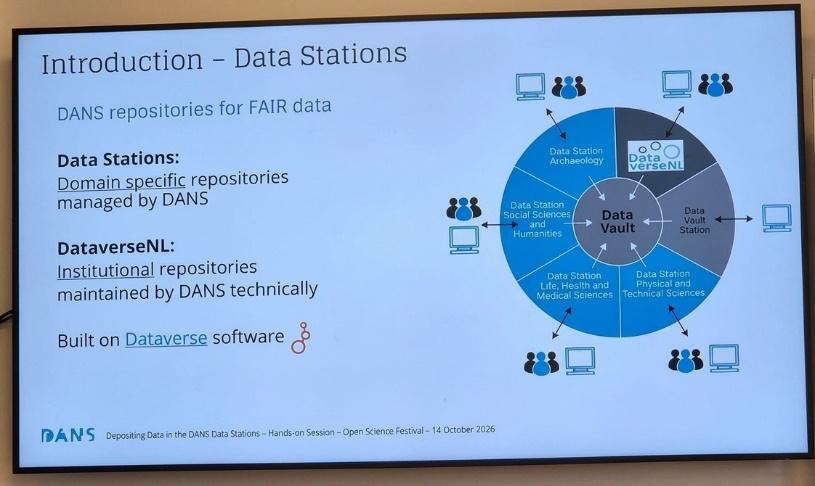
The hands-on session on depositing data in the DANS Data Station.
2. Test-driving the OpenAware Navigator, a decision-support tool for responsible open science
The second workshop introduced the OpenAware Navigator, a decision-support tool designed to help researchers and research supporters navigate decisions related to responsible open science.
What I found particularly interesting about this topic is that open science is not always a straightforward matter of making research openly available. Researchers must consider several aspects, including privacy, research ethics, copyright, intellectual property, sensitive information, and the appropriate conditions for sharing research outputs.
A decision-support tool can help users think through these considerations and make more informed decisions throughout the research process.
For the universities on the islands, this type of approach could be valuable when advising students, lecturers, and researchers about publishing, sharing research data, and making their work openly accessible.
It also reinforced the importance of the information specialist’s role: helping researchers understand not only where and how to publish, but also what they need to consider before sharing their research.
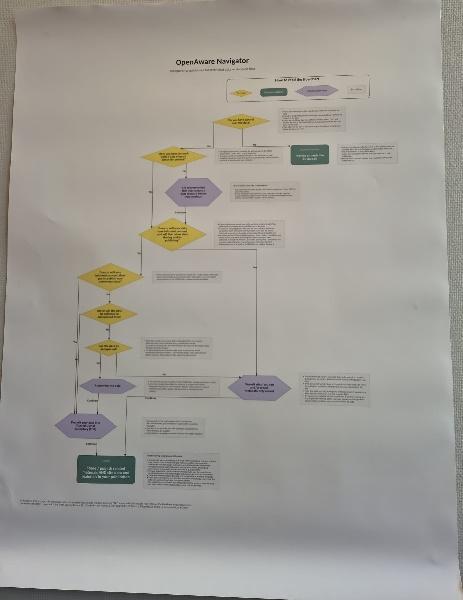
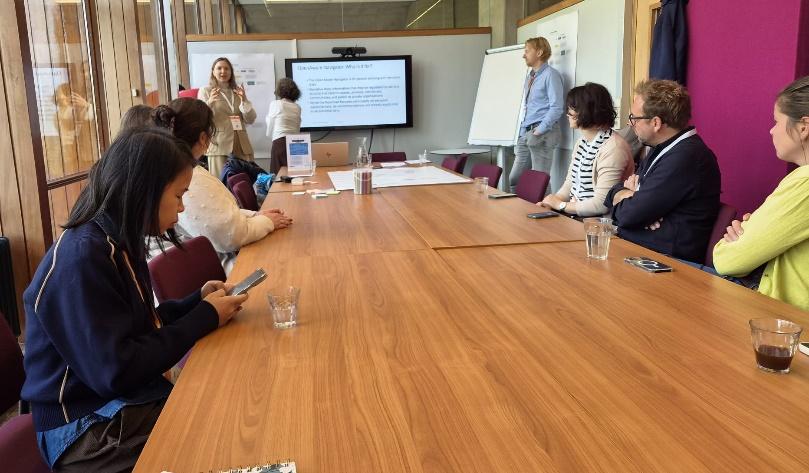
The OpenAware Navigator flowchart and the hands-on session test-driving it.
3. Public engagement pressure cooker: draft your public engagement activity
The third workshop took a more creative approach to open science. Its focus was on developing public engagement activities that strengthen the relationship between scientific research and a wider audience.
Researchers, educators, students, and research support professionals were invited to develop ideas for activities that could make research more understandable, accessible, and interesting to people outside academia.
This workshop reminded me that research should not remain within universities or academic publications. Knowledge becomes more valuable when it reaches communities, contributes to public discussions, and helps address real-world challenges.
For the Dutch Caribbean, public engagement is especially important. Universities and research institutions have an opportunity to connect academic knowledge with local communities, cultural heritage, education, and regional development.
I see opportunities to apply this approach through the DCDC Network, for example by organizing accessible research presentations, digital information activities, and initiatives that encourage researchers to share their findings with the wider community.
4. Train the trainer: preregistration for qualitative studies
The final workshop focused on preregistration in qualitative research and the role of training and education in promoting transparent research practices.
Preregistration involves documenting important elements of a research project before conducting the research or analyzing its results. Depending on the study, this can include research questions, methodology, sampling strategies, and planned approaches to data collection and analysis.
Although preregistration is often associated with quantitative research, it can also be valuable in qualitative studies. It encourages researchers to reflect on their research design, document their decisions, and make their research process more transparent.
The workshop’s train-the-trainer approach was particularly interesting because it focused not only on understanding the concept but also on how to transfer this knowledge to others.
For the universities in the network, this is relevant when supporting students and researchers who are preparing theses, conducting qualitative studies, or working on research projects. Libraries can contribute by helping researchers find appropriate guidance, understand research transparency, and identify resources that support good research practices.
It also highlighted an opportunity for professional development: building the knowledge and skills needed to guide and train others in open science practices.
What I took away from these workshops
Although the four workshops covered different subjects, they shared one important message: open science requires more than making research publications freely available.
It involves responsible data management, informed decisions about sharing information, meaningful engagement with society, and transparent research methods.
For me, the workshops demonstrated how the DCDC Network and academic libraries can contribute throughout the entire research lifecycle. We are not only providers of information and access to academic resources; we can also act as partners in research support, data stewardship, open science, and knowledge dissemination.
I returned home with renewed inspiration to explore how these ideas can be translated into practical improvements for the DCDC Network, the University of Curaçao and the wider Caribbean research community.
About the DCDC Network
The Dutch Caribbean Digital Competence (DCDC) Network was established in 2025 with funding from Open Science NL. It connects the Universities of Aruba, Curaçao, and St. Martin, and Instituto Pedagogico Arubano, with a shared mission: to make research data more reusable, accessible, and transparent across the Dutch Caribbean.